This is the second page explaining the figures obtained from your router linestats. The previous page detailed physical line conditions such as attenuation & SNR, whilst this page specifically looks at the various framing parameters and error counters.
A parameter if a figure that is set on the router and dictates such things as the amount of overhead for error correction. Counters monitor such things as errors that have occured and help provide an indication of line health.
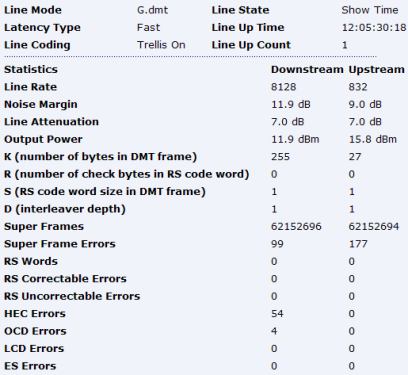
|
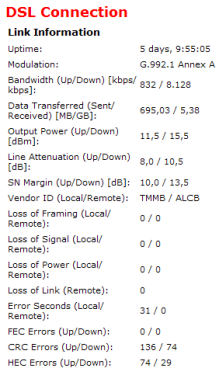
|
|
Line Stats from Voyager router
|
Linestats from Speedtouch router
|
~ Alphabetical List of line parameters and counters
ADR - Aggregate Data Rate.
AgR - Aggregate rate.
Assumed to be the throughput rate plus overhead bits.
B - B Value
Number of bytes in the MUX Data Frame
BER - Bit Error Rate
The ratio of Errored bits to Transmitted bits.
BERT = Bit Error Rate Test. Most modem/routers have a tool to check the Bit Error Rate.
CRC Errors - Cyclic Redundancy Check
Count of CRC errors. CRC is an error detection code used to verify packet transmission between the sender and receiving end. A CRC error indicates that part of the data packet is corrupt and requires retransmission. - see Cyclic Redundancy Check (CRC) for a more in depth explanation.
Many CRC errors in a short period of time will show a noticeable reduction in throughput speed. This can be an early indication that there is too much noise on the line and in extreme situations can lead to loss of sync (disconnection with the exchange).
D Value - Depth of Interleaving (INTLVDEPTH)
The Depth of Interleaving applied to the line. Various depths of interleaving may be applied by the DSLAM by both BTw and the LLU Operators. See Interleaving for more information.
The values range from 1 to 4096. A depth of 1 is the equivalent of Fast Path and no interleaving applied.
Delay
The delay due to interleaving being applied on the line - recorded in microseconds.
ES - Errored Seconds
A one second period of time in which either one or more coding violations occurred OR at least one Loss of Signal events occurred.
Its not unusual to see occasional ES and its best looking at the broader picture. Some routers will display the ES over 15 min periods (900 seconds), therefore a couple of errored seconds will probably go un-noticed. BT uses the ES count for its DLM.
ESF - Extended Super Frames
In DS1 systems an ESF extends the 12 frames per superframe, to 24 frames contiguously transmitted together.
Clarification is needed for the exact amount of frames used in an adsl ESF and reference is given to adsl SuperFrames.
FEC Errors - Forward Error Correction
Count of errors that have been corrected due to error correction being applied to the line. Error correction is turned on at the same time as Interleaving. Its normal to see FEC errors on an Interleaved line and rather than anything to be too concerned about its more an indication that the Interleaving & Error Correction process is working and doing what it should. - See Error Correction for more information.
HEC Errors - Header Error Check/Correction
Count of HEC Errors. HEC is a type of CRC error check which has been performed on the header of an ATM cell, but 1 bit errors can be corrected. This count is usually where HECs have been uncorrected and have been discarded.
If these errors are too high within a short period of time it will slow throughput... and could even lead to connection instability - See Out Of Cell Delineation.
I - I Value
The interleaver block size in bytes. Should be a sub-multiple of N
INP - Impulse Noise Protection
Level of Impulse Noise Protection - See Interleaving ~ INP
K Value - Bytes in the DMT Frame
Number of bytes in the Frame. Each Byte is said to give 32 kbps of sync speed.
eg (254 available bins x 32kbps = 8128) for downstream and (26 x 32 = 832) for upstream.
L - L Value (LSYMB)
Reports the actual number of bits per symbol assigned to the latency path in which the bearer channel is transported.
This value does not include trellis overhead and ranges from 0 to 65535. (vdsl) or Number of bits in PMD Data Frame (adsl2+)
LCD Errors - Lost Cell Delineation
Count of the number of Lost Cell Delineation errors - See LOCD
LOCD - Loss of Cell Delineation.
An alarm state process, different routers may have different alarm periods. A typical alarm integration period may be 2.5 seconds with a 10 second deactivation period.
A Loss of Cell Delineation defect is initially triggered when an Out of Cell Delineation (see OOCD) condition occurs and doesn't clear for more than 4ms. This starts then starts the integration period.
If the defect doesn't clear during the integration period, then an LOCD event is recorded.
The LOCD alarm event will clear when an LOCD defect is not detected within the deactivation period.
LOF - Loss of Framing
An alarm state process, different routers may have different alarm periods. A typical alarm integration period may be 2.5 seconds with a 10 second deactivation period.
A Loss of Frame defect is initially triggered when an Out of Frame (see OOF) condition occurs and doesn't clear for more than 3ms. This then starts the integration period.
If the defect doesn't clear during the integration period, then a LOF event is recorded.
The LOF alarm will clear when an LOF defect is not detected within the deactivation period.
LOL - Loss Of Link
Physical failure of the link.
A Loss of Link condition is declared if a Loss of Signal is not preceded by a dying gasp message.
LOM - Loss Of Margin
Not set on all modems and only relates to adsl2/adsl2+/vdsl. A parameter has to be set for the minimum tolerable noise margin. If the modem falls below this level, then a request is sent to increase the ATU-C transmit power. If an increase is not possible then the line will fail and attempt to re-initialise.
LOS - Loss of Signal
An alarm state process, different routers may have different alarm periods. A typical alarm integration period may be 2.5 seconds with a 10 second deactivation period.
A LOS defect may initially be triggered when all zeros are received for 20 microseconds which starts the integration period. During the integration period, 2 consecutive frames with 20 microseconds of signal loss will record a LOS event.
The LOS alarm will clear when no LOS defects are detected within the deactivation period.
A couple or so LOS events may go totally un-noticed during bursty activity such as web-browsing etc. The connection should be able to cope with this momentary loss of signal with the exchange, however a high level indicates a noise problem.
Some users have observed that 4 LOF events can trigger a LOS.
LPR - Loss of PoweR
Failed re-initialisation of the DSL link due to power loss. A dying gasp message has been sucessfully sent/received.
M - M Value
MUX Data Frames in FEC Data Frame or Number of Mux Data Frames in a RS codeword.
MSGC
Number of bytes in the overhead channel message.
N - N Value (NFEC)
RS codeword size. Reports the actual number of Reed-Solomon redundancy per codeword used in the latency path. Used with the R value to express the rate of FEC applied.
NCD - No Cell Delineation
See LOCD - Loss of Cell Delineation
OCD Errors - Out-of Cell Delineation
Count of out-of-cell delineation errors - see OOCD.
OHF Errors (OHFErr)
Overhead Frame Errors. Similar to CRC Errors.
OOCD - Out Of Cell Delineation
Out of Cell Delineation event occurs when seven consecutive cells fail to contain a valid HEC (Header Error Check). An OOCD clears when six consecutive HEC valid cells are detected.
OOF - Out Of Frame
An Out of Frame event occurs when four consecutive frames do not contain a valid frame word. OOF clears when two valid consecutive frames are detected.
OR - Overhead Rate
R Value - RS check Bytes (RFEC)
Number of (redundant/parity) bytes occupied by the Error Correction process (overhead).
Often used to describe the level of error correction and can range from 0 to 20. The more check bytes that are used then the more errors can be corrected. The value 0 indicates no Reed Solomon coding. Use this value with N to express the rate of FEC applied as a percentage. eg R/N
RS Correctable Errors
The number of Reed-Solomon code words with correctable errors. Reed-Soloman is a method of Forward Error Correction and therefore a count of data successfully recovered. See FEC.
RS Uncorrectable Errors
The number of Reed-Solomon code words that had uncorrectable errors. Reed-Soloman is a method of Forward Error Correction. Uncorrectable Errors are those that are too severe to be corrected by FEC.
RS Words
Count of the total number of Reed-Solomon code words transmitted/received.
S - S Value
Ratio of FEC over PMD Data Freme length or Number of data symbols the RS codeword spans
SES - Severely Errored Seconds
As the name indicates this is worse than an Errored Second (which
only needs one event to trigger an ES).
A Severely Errored Second is a one second period which contains 30% or more errored
blocks OR several other events such as one or more OOF.
Note: It has been observed that a LOS event may be preceeded by a SES if the LOS was not preceeded by a LPR event. ie The dying gasp message appears to prevent an additional SES being recorded before an LOS.
SF - Super Frames
Traditionally, a (Digital Signal 1) superfame consists of 24 frames contiguously transmitted together.
In adsl, a superframe consists of 68 adsl frames plus a synchronisation frame.
The adsl modem generates 4000 frames per second. The global duration of an adsl superframe is 17ms.
SFE - Super Frame Errors (SFErr)
Count of the Super Frames received which had an error. This is similar to CRC error.
T - T Value
MUX Data Frames over sync bytes or Number of Mux Data Frames in an OH sub-frame
Total ES / ESF
The total Extended Super Frame errors - See ESF
UAS - Unavailable seconds
Ten consecutive SES's will trigger a UAS event, and will remove the path from use. The path will become usable again after 10 consecutive seconds with no SES.
A count of UAS events can be triggered by a LOS event and will continue to accrue for each second that the system is up and the path is unavailable.
~ Reed Solomon Parameters (Error Correction)
MSGc = Number of bytes in overhead channel message
K = Number of bytes in the DMT Frame
B = Number of bytes in the data frame
N = NFEC = Length of codeword (N = K + R)
R = RFEC = RS check bytes / Amount of redundancy
S = Symbols per codeword / No of data frames per codeword
T = Number of dataframes in an OH subframe/ Data frames over sync bytes
Q = Number of RS codewords per DTU (g.inp)
V = Number of padding octets per DTU (g.inp)
~ Interleaving Parameters
I = Number of Interleaver branches / The interleaver block size in bytes. Should be a sub-multiple of N.
J = Interleaving depth. (J = M * K + 1)
K = Interleaver block length. K = L symbols (equal to or divisor of N)
M = Incremental delay / Number of Mux Data Frames in FEC Data Frame/RScodeword
D = Interleave Depth. (D = M * I + 1)
L = LSYMB = Number of bits per symbol in the latency path / Number of bits in PMD data frame
Interleaving introduces a delay of M * I * (I-1)
Actual delay - ADSL shown in ms = [S x D]/4
Actual delay - If retransmission is used this specifies the actual value of the time independent component of the delay due to retransmission only.
Note: VDSL uses a triangular interleaver.
~ G.INP Retransmission Parameters & Counters
rtx_tx = Count of retransmitted DTUs.
rtx_c = Count of detected and corrected retransmissions.
rtx_uc = Count of detected DTU errors which have not been corrected within the delay_max constaint.
EFTR = Error-free throughput
SEFTR = Severe Loss of error-free throughput
LEFTR = Loss of Error Free Throughput -
Count of seconds with a defect
errFreeBits = Error-free bits counter - bits originating from the DTU that have been detected to contain no error at the moment of crossing the β1-reference point.
minEFTR = Minimum Error Free Throughput
minEFTR is a performance monitor measured at showtime of the minimum of the EFTR observed in the seconds since the last reading of the EFTR_min, excluding the following seconds.
– seconds in which the values of EFTR are less than ETR/2;
– seconds in which EFTR is not defined;
– the single second preceding a second with seftr defect;
– the single second following a second with seftr defect.
[note: appears to bear some resemblance to sync speed]
INP value defines the size of retransmission queue.
INPREIN defines the amount of Interleaving & FEC.
The interleaving used on Latency path #1 shall be a block interleaving. The interleaving block shall have a size of D1 × NFEC bytes, with NFEC being the length of the RS codeword, and D1 being the interleaving depth. If D1=1, then an interleaving block equals an RS codeword. If D1=Q (the number of RS codewords per DTU) then an interleaving block equals a DTU. Each byte Bk within an interleaving block (input at position k, with index k in the interval 0 to D1 × NFEC – 1) shall be located at the output of the interleaving function at position l given by l = i × D1 + j, where i = k MOD NFEC and j = floor(k / NFEC).
|



 Rate your ISP


